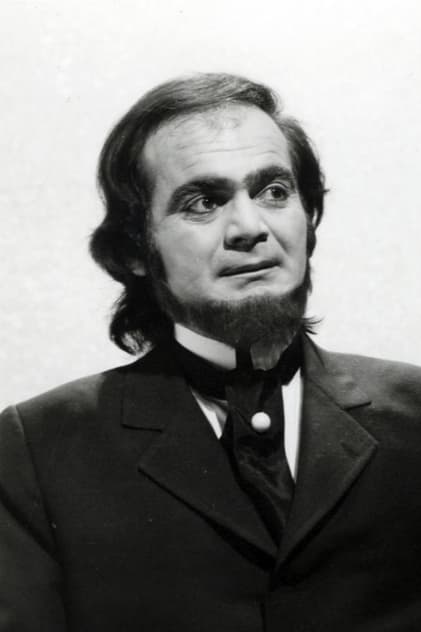
Stelios Kapatos

Stelios Kapatos

Stelios Kappatos was born in 1938 and grew up in Ilioupoli, Athens, originally from Dilinata, Kefalonia. He was for a long time, a key and permanent member of the State Theater of Northern Greece. His presence at the State Theater of Northern Greece was great, where he served from 1971 until his death, performing many classical roles in more than 40 plays. In 1964 he made his first professional appearance in the theater with Elli Lambeti's troupe. More important, "Leoforeion o Pothos" (1965), "Nefeles" (1978) with Thymios Karakatsanis (Strepsiadis), and himself, in the role of Xanthia. In 1980-1981 he starred with Dionysis Pagoulatos in the play, "O Aforesmenos" by Laskaratos. Also in the Tragedy "Helen", of the KTHBE directed by Andreas Voutsinas, where Stelios Kapatos played an Egyptian Messenger. Stelios Kappatos died in Thessaloniki on November 3, 1987 at the age of only 49.

  • Title: Stelios Kapatos
  • Popularity: 0.2223
  • Known For: Acting
  • Birthday: 1938-01-01
  • Place of Birth: Athens, Greece
  • Homepage:
  • Also Known As: Στέλιος Καπάτος, Στέλιος Καππάτος
img

Stelios Kapatos Movies

  • 1980
    imgMovies

    Alexander the Great

    Alexander the Great

    6.8 1980 HD

    Alexander, a tribal warlord and former political prisoner, kidnaps British tourists, holding them for ransom until Britain and the Greek puppet government in Athens meet his demand for amnesty for his band of freedom fighters.

    img
  • 1976
    imgMovies

    May

    May

    1 1976 HD

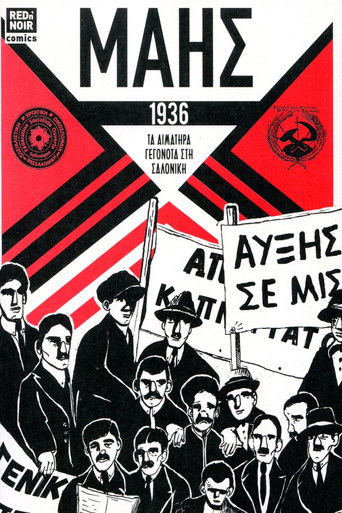
    The days of May 1936 in Thessaloniki and the events that led to the bloody clashes between the tobacco workers and the army are described in this film in a clear way. The people are the protagonists, and the narrative does not insist on drama or exaggeration. Of particular importance is also the presentation of the way in which the country was led, through a specific plan, to the dictatorship of Metaxas, on August 4, 1936.

    img
  • 1987
    imgMovies

    Doxobus

    Doxobus

    5.3 1987 HD

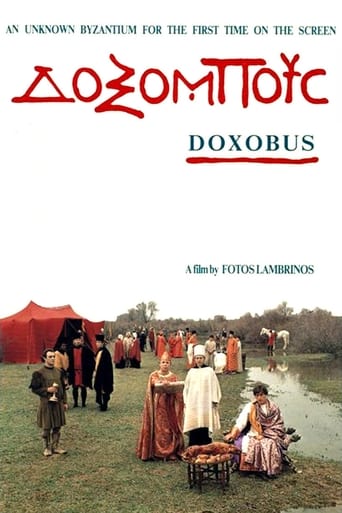
    By the 14th century, the Byzantine Empire was, if not on the verge of actual collapse, at least seriously decadent and clearly on its last legs. The hungry wolves of Europe were preparing to dine on its corpse, and as a result the Byzantine army and its allies were constantly engaged in battles and skirmishes. In this story, a widow lives in the 14th-century Byzantine village of Doxobus with her son Xenos. She forms a relationship with a village elder, and when she gives birth to the elder’s son, her son from her previous marriage is sent to live in a monastery.

    img
  • 1974
    imgMovies

    The Reason Why

    The Reason Why

    6 1974 HD

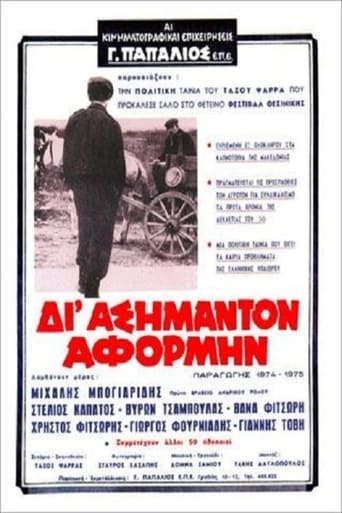
    Michalis returns to the tobacco growers of his rural village after having spent some time in the city and persuades them to form a collective, rather than suffer the poverty-inducing prices they are paid for their crops by tobacco brokers. They agree not to sell to any of the brokers and start to form a farmers' group. When one of the farmers breaks the agreement and is found dead, Michalis is accused. However, rather than expose the farmers' plight and give publicity to the brokers' greed, the motive the government gives for the killing is thi asimanton aformin, for unimportant reasons.

    img
  • 1969
    imgMovies

    Wounded youth

    Wounded youth

    1 1969 HD

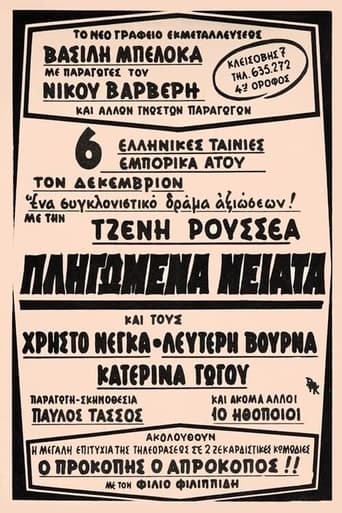
    A girl from the countryside, Marina (Katerina Gogou), comes to Athens to work in the shop of a family friend (Theodoros Katsadramis) of her father. She rents an apartment with a naive girl (Jenny Rousea), who will be married by a lazy womanizer (Lefteris Vournas). The latter, after throwing out her husband, will leave their baby with Marina and disappear. After six years, she will return and ask for her daughter back. However, Marina, who has raised the little girl as her own child, refuses to grant her request. They arrive at the courts, where despite the support of her suitor and lawyer (Christos Negas), she will be forced to part with little Rinoula.

    img